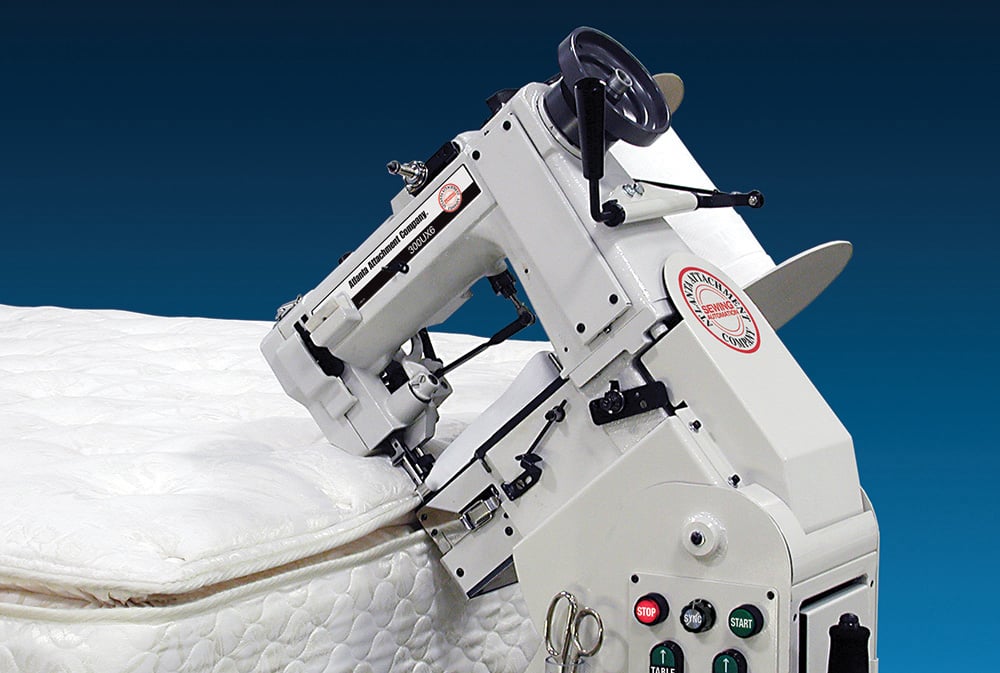
Mattress Tape Edge Machines: Creating a Consistent Finish in Mattress Production
The final assembly stages of mattress manufacturing require accuracy, strength and a consistent finish. Once the internal mattress construction, comfort layers, quilted panels and borders have been prepared, these individual components need to be securely joined. One of the most recognisable processes used to complete this assembly is tape edging, where a narrow strip of material is sewn around the perimeter of the mattress.
Mattress Tape Edge Machines are specialist industrial sewing machines designed specifically for this operation. Rather than requiring an operator to manipulate a large mattress around a conventional sewing machine, tape-edge equipment provides a working arrangement suited to the size and three-dimensional shape of the product. Depending on the machine, the sewing head, working platform or mattress can be repositioned as the seam progresses around the perimeter.
Tape edging performs both a functional and visual role. The tape covers and joins the edges where the mattress panel and border meet, helping create a secure seam while providing the characteristic finished appearance seen around many mattresses. Because this seam runs around the complete product, inconsistencies can be highly visible.
The operation also presents practical challenges that are unusual in conventional textile sewing. A mattress is large, relatively heavy and difficult to manoeuvre, particularly once all of its internal components have been assembled. The operator needs to maintain control of the tape, mattress panel and border while producing an even seam around straight sections and corners.
Specialist machinery can make this process considerably more manageable. The working height, sewing-head position and material-guiding arrangements are designed around mattress construction, allowing the operator to concentrate on maintaining an accurate seam rather than attempting to support the entire weight of the product.
Different mattress constructions can require different machine settings. A relatively shallow foam mattress may behave differently during tape edging from a deep pocket-sprung or hybrid product containing several comfort layers. The machine therefore needs to accommodate the range of mattress depths and dimensions normally produced within the factory.
Thread, needle selection and tape specification also influence the finished result. These elements need to be suitable for the materials being joined and the demands placed upon the seam during handling and normal mattress use.
Tape Edging and Production Efficiency
Although the tape-edge seam is completed relatively late in production, its efficiency can affect the output of the entire factory. By this point, considerable manufacturing time and material have already been invested in the mattress. A problem during final sewing can therefore be more costly than a defect identified during an earlier component-production stage.
Good preparation helps reduce these problems. Quilt panels should be correctly sized, borders should be accurately assembled and internal components should be properly positioned before the mattress reaches the tape-edge workstation. Expecting the tape-edge operator to compensate for significant dimensional differences can result in uneven seams or distortion.
Corners require particular attention because the direction of sewing changes while the tape needs to remain positioned consistently. Operator experience can have a significant influence on the quality of this part of the process. Guides and specialist machine features can assist, but the person operating the equipment still needs to understand how the mattress materials behave as they move through the sewing area.
The physical handling of the mattress can account for a substantial proportion of the overall operation. Consequently, improvements in productivity do not necessarily come from increasing sewing speed alone. A machine that allows the operator to turn, lift or reposition the mattress more efficiently may reduce the total cycle time even if the actual stitching speed remains similar.
This is particularly relevant for larger mattresses. King, super king and deeper premium products can become difficult to manoeuvre repeatedly during a full production shift. Suitable Mattress Tape Edge Machines may incorporate powered tables, lifting mechanisms or other handling features designed to reduce the amount of manual movement required.
Ergonomics should form part of workstation planning for the same reason. Repeatedly manipulating large mattresses can place physical demands on operators, so table height, access to controls and the movement required to position the product should all be considered. Efficient material handling can support both productivity and a more practical working environment.
Factory layout can further improve the process. Tape edging normally takes place after most major mattress assembly operations and before final inspection and packaging. Positioning the workstation logically within this production sequence reduces unnecessary movement of bulky completed products around the factory.
The capacity of the tape-edge operation should also be balanced against earlier manufacturing stages. If quilting, border preparation and mattress assembly collectively produce mattresses faster than tape edging can complete them, products will accumulate before the final sewing stage.
Manufacturers can assess realistic cycle times to determine how many tape-edge workstations are required for the intended production volume. High-volume facilities may operate several machines, while smaller manufacturers may depend heavily on a single workstation.
Automation, Maintenance and Consistent Quality
Automation is increasingly used to reduce repetitive actions within mattress production. Tape edging remains an operation where material behaviour and mattress handling require careful control, but modern equipment can automate parts of the process that previously depended entirely on manual intervention.
Automatic sewing-head positioning, powered mattress movement and programmable controls can reduce some of the physical handling required from the operator. More advanced systems may automate substantial portions of the tape-edge cycle, depending on the mattress construction and equipment involved.
The appropriate level of automation depends on production requirements. A factory producing large quantities of standardised mattresses may benefit from highly repeatable automated processes, while a manufacturer frequently changing between bespoke sizes and constructions may place greater value on flexibility.
Changeover time should therefore be considered alongside maximum production speed. If a manufacturer produces several mattress depths and sizes every day, equipment that can be adjusted efficiently between specifications may provide greater practical productivity than machinery optimised exclusively for one product.
Quality should remain the central consideration because tape edging is highly visible on the finished mattress. Stitch length, tape positioning, thread tension and the alignment between the border and panel all contribute to the final appearance.
Operators should inspect the seam as it is being produced rather than waiting until the complete mattress has been finished. Identifying a problem after only a short section has been sewn can make correction considerably easier.
Needles are routine consumable components and should be checked regularly. A worn or damaged needle can create skipped stitches, damage materials or cause repeated thread breakage. Correct needle selection is particularly important when the machine needs to penetrate several layers around the mattress edge.
Thread tension should also be appropriate for the materials being sewn. Excessive or insufficient tension can affect stitch formation and the appearance of the seam. Changes in mattress construction, tape or thread may therefore require adjustments rather than assuming one setup is suitable for every product.
Tape feeding needs to remain consistent throughout the operation. The tape should cover the joined edge evenly without excessive stretching, twisting or wandering away from the intended position. Guides can assist with this, but their setup should be checked whenever different tape specifications are introduced.
Routine maintenance helps preserve this accuracy. Thread fragments, fibres and dust can accumulate around sewing mechanisms during production, particularly within factories processing large quantities of textile and filling materials. Regular cleaning can help prevent contamination from interfering with moving components.
Lubrication and servicing should follow the manufacturer's requirements. Hooks, feed mechanisms, belts, bearings and other moving parts can experience substantial use when machinery operates throughout multiple production shifts.
Preventative maintenance is particularly important where a factory relies on one Mattress Tape Edge Machine for all final assembly. A failure at this workstation can quickly interrupt production because mattresses cannot progress normally towards inspection and packaging.
Maintaining commonly required consumables and replacement parts can reduce the duration of relatively minor stoppages. Production records can also help identify recurring faults or components that require replacement at predictable intervals.
Operator training provides another layer of preventative maintenance. Experienced operators often recognise subtle changes in machine sound, vibration, feeding or stitch formation before a major fault develops. Reporting these changes early allows maintenance to be scheduled before the equipment fails completely.
Safety systems should remain fully operational. Industrial tape-edge machinery combines rapidly moving sewing mechanisms with equipment designed to manipulate large products, so guards, emergency stops and other protective features should never be bypassed simply to reduce cycle times.
Ultimately, Mattress Tape Edge Machines perform one of the final and most visible sewing operations within mattress manufacturing. Suitable equipment can help manufacturers join panels and borders accurately while making large mattresses easier to handle throughout the sewing process. Combining appropriate machinery with skilled operation, efficient workstation design, quality control and preventative maintenance can support consistent finishing while helping the complete mattress production line operate efficiently.